
Choosing flooring in 2026 is no longer just about appearance — it’s a technical decision that directly affects your comfort, maintenance costs, and how your home performs over time.
Many homeowners initially focus on design — color, texture, wood imitation — but in practice, the real difference between a good and a bad flooring decision appears after 1–3 years of use. Scratches, swelling, noise, and wear patterns quickly reveal whether the material was chosen correctly.
This is why a proper LVP vs laminate vs hardwood comparison must consider not only aesthetics, but also:
- how the floor behaves under daily stress
- how it reacts to moisture and temperature changes
- how much effort it requires to maintain
Understanding these factors allows you to choose flooring that not only looks good on day one, but still performs well years later.
Fast comparison guide: vinyl vs laminate vs wood
- Cheapest option: Laminate
- Best waterproof performance: Waterproof vinyl flooring (LVP)
- Best durability overall: 20 mil LVP or hardwood (depending on use)
- Best for kitchens & bathrooms: LVP
- Best resale value: Hardwood (but LVP is catching up)
- Best for pets & kids: Pet-friendly flooring = LVP
This quick summary reflects real-world performance, not just marketing claims — and is especially relevant for modern households with active daily use.
Flooring comparison: vinyl vs laminate vs hardwood (overview)
When comparing flooring types, it’s important to understand that each material is built differently at a structural level.
Luxury vinyl plank is a multi-layer engineered product, designed specifically for resistance to moisture, impact, and wear. Laminate, on the other hand, is a compressed fiberboard core with a decorative layer, which makes it more sensitive to water. Hardwood is a natural material, valued for authenticity but less forgiving in demanding environments.
| Feature | Luxury Vinyl Plank | Laminate | Hardwood |
| Waterproof | Yes (true waterproof vinyl flooring) | No (water-resistant only) | No |
| Durability | High (12–20 mil wear layer) | Medium | High but scratches |
| Cost | $$ | $ (cheapest flooring option comparison winner) | $$$ |
| Maintenance | Easy | Moderate | High |
| Resale value | Medium–High | Medium | High |
| Pet-friendly | Excellent | Moderate | Poor |
The key takeaway here is that no single flooring is “best” universally — the right choice depends on your lifestyle.
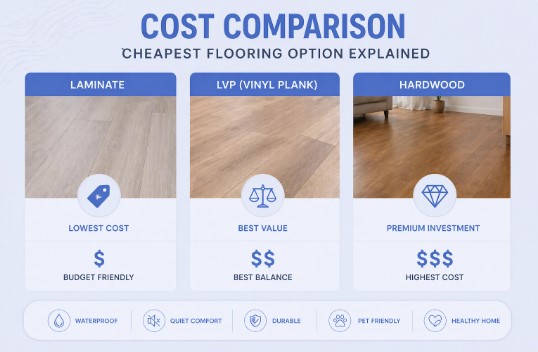
Cost comparison: cheapest flooring option explained
At first glance, laminate appears to be the clear winner in any cheapest flooring option comparison, but focusing only on upfront price can be misleading.
Flooring should be evaluated based on total cost of ownership, which includes:
- installation
- maintenance
- repairs
- replacement cycle
For example, laminate may cost less initially, but if it needs replacement after 7–10 years due to moisture damage or wear, the long-term cost increases significantly.
Luxury vinyl plank sits in a balanced middle position — slightly more expensive upfront, but far more stable and durable in everyday conditions. Hardwood, while expensive, can last decades — but only with proper maintenance and periodic refinishing.
In real scenarios, many homeowners find that LVP offers the best balance between price and long-term performance, especially in active homes.
Durability deep dive: luxury vinyl vs laminate durability
Durability is often misunderstood because buyers focus on thickness instead of surface protection technology.
In LVP, durability is defined by the wear layer — the transparent protective coating that absorbs daily damage. A 12 mil wear layer is sufficient for standard residential use, while 20 mil LVP is designed for heavy traffic, pets, and high-impact areas.
Laminate, in contrast, relies on an AC rating system, which measures abrasion resistance but does not protect against water infiltration. This means laminate can handle foot traffic relatively well but fails under moisture exposure.
Hardwood offers structural longevity but suffers from surface vulnerability. It scratches easily, especially in homes with pets, and requires refinishing to restore its appearance.
In practical use, luxury vinyl vs laminate durability clearly favors LVP, particularly in households where spills, movement, and wear are constant.
Waterproof performance: where LVP dominates
Water resistance is one of the most critical factors in modern flooring decisions — especially in kitchens, bathrooms, and open-plan homes.
Luxury vinyl plank is engineered with a waterproof core (SPC or WPC), meaning that water cannot penetrate or damage the material. This makes it suitable for environments where spills, humidity, and cleaning are frequent.
Laminate flooring, despite often being marketed as “water-resistant,” is vulnerable at the seams. Even small amounts of moisture can cause swelling, which is irreversible.
Hardwood is the most sensitive option — exposure to water can lead to warping, staining, and long-term structural damage.
This is why waterproof vinyl flooring has become the standard choice for modern interiors, especially in high-risk areas.
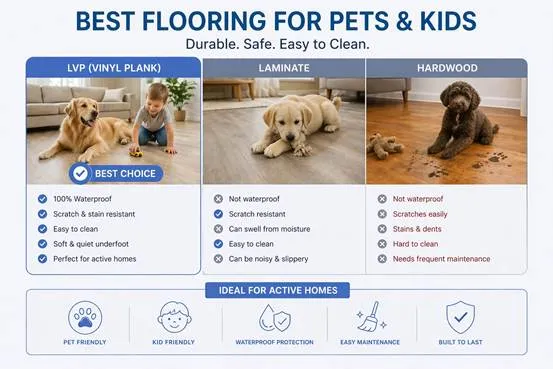
Which flooring is best for pets and kids?
Homes with pets and children place unique demands on flooring. It’s not just about durability — it’s about how the floor responds to unpredictable situations.
Claws, toys, spills, and constant movement require a surface that can absorb impact without showing damage.
LVP is specifically designed for this type of environment. With a 20 mil wear layer, it resists scratches, while its waterproof structure ensures that accidents do not cause long-term issues.
Laminate may initially seem durable, but it can become slippery and is vulnerable to moisture. Hardwood, while beautiful, often shows scratches quickly and requires careful maintenance.
This makes LVP the most reliable pet-friendly flooring option available today.
Vinyl plank vs hardwood resale value (2026 update)
Resale value is evolving. While hardwood has traditionally been seen as the premium option, buyer preferences are shifting toward practicality and low maintenance.
Modern buyers increasingly value:
- durability
- waterproof performance
- ease of care
High-quality LVP now meets all these expectations, making it more attractive in many real estate markets.
While hardwood still holds prestige, LVP is becoming a smart, modern alternative, particularly in family homes and urban properties.
The gap in vinyl plank vs hardwood resale value is narrowing every year.
Maintenance comparison: which flooring is easiest?
Maintenance is often underestimated during the buying process, but it has a significant impact on long-term satisfaction.
LVP requires minimal effort — regular sweeping and occasional mopping are enough to maintain its appearance. It does not require special products or treatments.
Laminate requires more caution. Excess moisture must be avoided, and damaged sections are difficult to repair.
Hardwood demands the most attention. It requires:
- specific cleaning products
- humidity control
- periodic refinishing
For most homeowners, especially busy families, LVP offers the most stress-free maintenance experience.
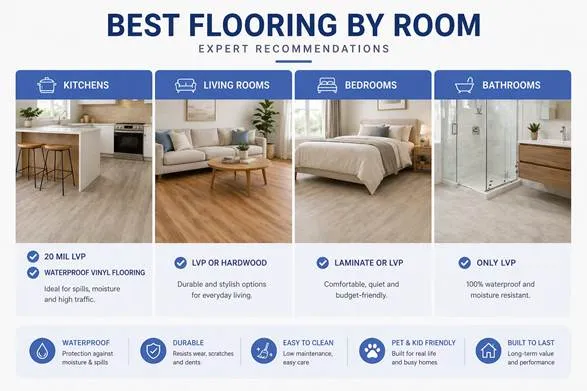
Best flooring by room (expert recommendations)
Choosing flooring by room ensures you’re not overpaying for performance where it’s not needed — or underinvesting where durability is critical.
For example, a bedroom has minimal stress, while a kitchen experiences constant activity, moisture, and impact.
This is why a strategic approach to flooring selection leads to better long-term results.
Kitchens:
- 20 mil LVP
- waterproof vinyl flooring
Living rooms:
- LVP or hardwood
Bedrooms:
- laminate or LVP
Bathrooms:
- only LVP
Matching flooring to room function is one of the most effective ways to optimize both cost and performance.
Expert flooring questions answered (2026 real-world guide)
Is luxury vinyl plank better than laminate flooring?
Yes, luxury vinyl plank is better than laminate in most cases due to its waterproof construction and higher durability. It performs better in kitchens, bathrooms, and high-traffic areas where laminate can fail.
Which is better: LVP or hardwood?
LVP is better for practicality, durability, and low maintenance in everyday homes. Hardwood is better for aesthetics and traditional resale value.
Which lasts longer: luxury vinyl plank or laminate?
Luxury vinyl plank lasts longer than laminate, especially with a 12 mil wear layer or 20 mil LVP. Laminate is more prone to moisture damage and edge wear over time.
Which flooring adds the most resale value in 2026?
Hardwood adds the most resale value due to its premium perception. However, high-quality LVP is increasingly competitive in modern real estate markets.
Which flooring is most durable for high-traffic homes?
20 mil LVP is the most durable option for high-traffic homes. It resists scratches, dents, and daily wear better than laminate or hardwood.
Which flooring is best for kitchens and bathrooms?
Waterproof vinyl flooring (LVP) is the best choice for kitchens and bathrooms. It fully resists moisture, unlike laminate and hardwood.
Is luxury vinyl plank really waterproof?
Yes, high-quality LVP is fully waterproof due to its rigid core construction. It does not swell or warp when exposed to moisture.
What flooring is easiest to maintain: LVP, laminate, or hardwood?
LVP is the easiest flooring to maintain because it requires minimal care and no refinishing. Hardwood requires the most maintenance, while laminate needs moisture control.
Which flooring is better for pets and kids?
LVP is the best pet-friendly flooring because it resists scratches and is easy to clean. It also provides better safety and durability for active households.
Is laminate cheaper than luxury vinyl plank and hardwood?
Yes, laminate is the cheapest flooring option upfront. However, LVP often provides better long-term value due to higher durability and lifespan.
Conclusion: which flooring should you choose?
There is no universal answer — but there is a clear trend.
Modern homeowners increasingly prioritize:
- durability
- moisture resistance
- ease of maintenance
This shift explains why LVP is rapidly becoming the dominant flooring choice.
Final recommendation:
6–8 mm LVP + 12–20 mil wear layer + waterproof core
This setup delivers:
- long-term durability
- resistance to daily wear
- protection against moisture
- strong overall value
Expert note: choosing the right flooring supplier
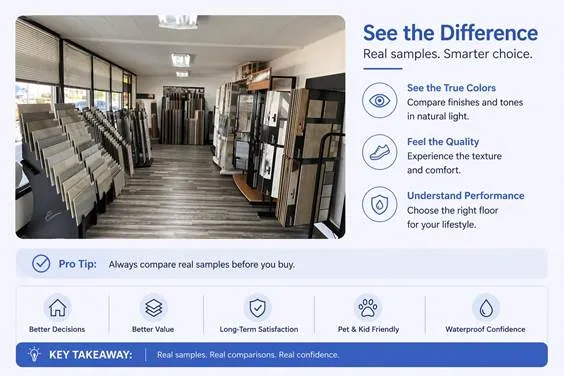
When selecting flooring, the product itself is only part of the equation — equally important is choosing a supplier that understands real-world performance, not just specifications on paper. This is especially critical when comparing options like LVP, laminate, and hardwood, where small differences in quality can significantly impact durability and long-term value.
IntraFlooring is a flooring company that focuses on practical solutions for modern homes, offering carefully selected luxury vinyl plank, laminate, and hardwood options based on real usage scenarios. Their approach emphasizes durability, waterproof performance, and suitability for high-traffic environments, which aligns with the key factors discussed in this guide.
For homeowners looking to make a balanced decision between cost, durability, and maintenance, working with a specialized flooring provider can make the selection process much more efficient and reliable.