

Building backlinks can feel like trying to make friends at a party where everyone is holding a clipboard. You want people to notice your site, but nobody enjoys a conversation that begins, “Could you please link to me?” The good news: effective link building strategies are less about asking strangers for favors and more about making useful things, finding the right people, and showing up consistently. Think of it as networking with fewer name tags and more browser tabs.

Start with pages worth recommending
Before pursuing links, decide which pages deserve them. A link to a thin page is like sending guests to a restaurant with a beautiful sign and an empty kitchen. Choose pages that answer real questions, explain a useful process, offer original research, or help readers make a decision. Improve those pages first: clarify the headline, add examples, check facts, and make the next step obvious.
Then look for pages that are already close to earning more organic traffic. A useful article sitting just outside the top search results may need a few meaningful improvements and stronger references, not a total renovation. Prioritize a small group of pages rather than trying to promote every URL at once. Focus is not glamorous, but neither is alphabetizing your spice rack—and both save time later.
Make the first month a research month
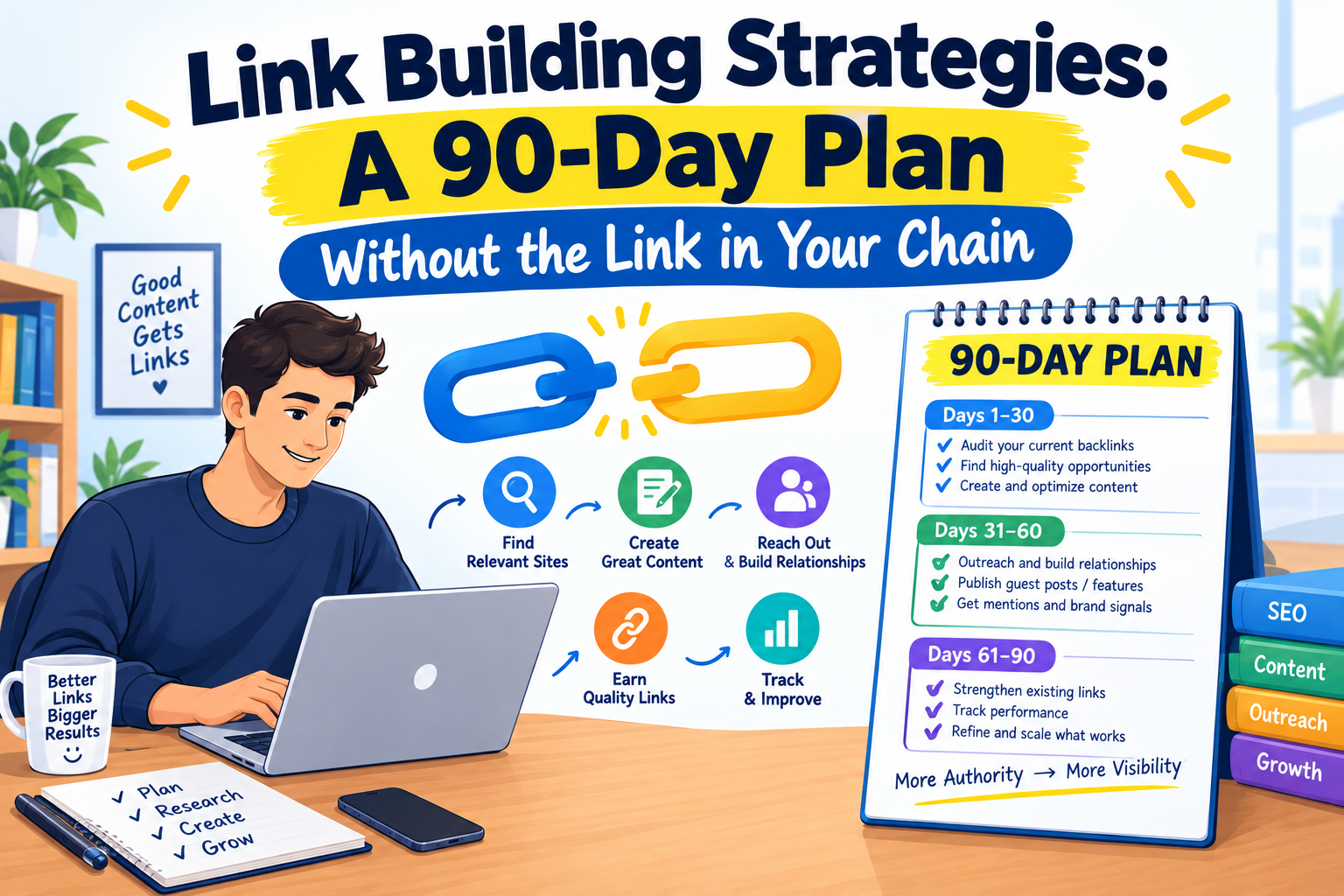
In days 1–30, investigate before you outreach. Review competitors that attract links in your subject area. Ask what people link to: original statistics, a strong explainer, a free resource, a memorable visual, or an expert answer. You are looking for patterns, not permission to copy. If several publishers cite a clear checklist, for instance, you might create a more complete checklist with examples that fit your audience.
Build a list of relevant publishers, writers, organizations, and resource pages. Relevance matters more than a giant spreadsheet full of sites that would never naturally mention your work. Note what each site publishes, who its readers are, and whether your page genuinely adds something. A link from a closely related, trustworthy page can be more useful than a dozen links from places that have about as much connection to your topic as a penguin has to a pomegranate.
For a structured timeline covering target-page selection, publisher research, competitor checks, and tracking, use this practical 90-day link-building plan as a starting point. The important part is to turn research into a manageable routine—not to collect so many prospects that your spreadsheet starts demanding its own office.
Month two: create and make contact
Days 31–60 are for producing useful material and beginning thoughtful outreach. A publisher is more likely to cite a page that makes its own article better. That might be a fresh survey, a concise how-to guide, a set of examples, or an expert perspective that answers a question its readers already have. Originality does not require inventing a new branch of physics. It does require giving people a reason to choose your page over the first five search results.
When you contact someone, keep the note specific and brief. Mention the relevant page, explain what your resource contributes, and let the editor decide whether it fits. Avoid mass emails with “Dear Webmaster” energy. If your pitch could be sent unchanged to a bakery, a bicycle shop, and a marine biology journal, it probably needs another edit.
Use natural anchor text—the clickable words that describe a linked page. A link should make sense in its sentence, rather than forcing an awkward exact-match phrase into every paragraph. Repeating the same keyword-rich anchor can look artificial to readers and search engines alike. Good links read as though a person added them to help someone, because that is precisely the impression you want to create.
Month three: follow up, learn, and refine
Days 61–90 are not a cue to send “Just circling back” every Tuesday until your prospect moves to a cabin without Wi-Fi. Follow up politely once when appropriate, then spend your effort on other promising opportunities. Track outreach, replies, placements, and the pages receiving links. Also monitor changes in organic visits and rankings, while remembering that search performance has many influences and rarely follows a perfectly punctual calendar.
A simple weekly review can reveal what deserves more attention:
- Keep: pitches and page formats that earn relevant responses or links.
- Improve: pages that attract interest but lack enough depth, clarity, or evidence.
- Stop: tactics that produce irrelevant placements or consume time without useful results.
Do not judge the whole campaign by one dramatic ranking jump—or one stubborn week. Consistent publishing, careful outreach, and genuine relevance tend to compound gradually. The best backlink is not a trophy to mount above your desk; it is a path that sends the right reader to something worth reading.
Make the assets look as good as they work
Useful content still has to be easy to understand and pleasant to explore. Clear diagrams, polished charts, and strong page layouts can help a resource earn attention, especially when the subject is complicated. If you are planning a visual refresh, Osdire’s guide explains how much does it cost to hire a graphic designer and what to consider when comparing freelance, in-house, and agency options. A clear brief and realistic budget can keep the design process from turning into a game of “guess what the client meant.”
Ultimately, link building works best when it is treated as relationship-building with receipts: make something useful, find the people who would value it, and keep track of what happens. Do that for 90 days and you will have more than a pile of links. You will have a sharper site, a better sense of your audience, and fewer reasons to panic-refresh your rankings before breakfast.